- AI Sales Agent
- AI SDR
- Sales Automation
- Verified Email Finder
- Email Warmup
- Lead Enrichment
- Cold Outreach
Best AI Sales Agent Tools in 2026
What Is an AI Sales Agent?
An AI sales agent refers to the general category of outbound sales software that requires minimal human input beyond initial prompts - searching for leads, cold outreach messaging, reply interpretation and qualification, and meeting scheduling, frequently fully automated from one input such as a company URL.
Unlike early rule-based outbound bots, which typically followed one set of instructions for every scenario, AI sales agents can interpret context and nuance to affect the most efficient next step in the sales process determining whether a prospect’s reply to an outreach message constitutes a counter-question, a quibble, or agreement to the next step, without requiring a human to program every potential permutation of logic.
Within this category there is tremendous variety: some tools lean much more heavily towards simple email drafting while others fully automate an end-to-end outreach and sales sequence up to scheduling a meeting. The specific capabilities of a given tool should be evaluated on a case-by-case basis.
AI Sales Agent Tools Worth Knowing in 2026
Clay - Best for Data Enrichment Feeding Other Agents
Overview
Clay is a data enrichment API that aggregates prospect and company-level information from dozens of third-party providers and injects it into whatever outreach/CRM workflow a team is already using. Unlike most agents on this list, Clay doesn’t perform outreach itself - it only helps other tools and representatives by providing additional context and background on sales prospects.
Key Features
Clay aggregates first-party data from 50+ providers and third-party sales tools into a single unified profile
Create custom “formulas” that calculate a prospect’s qualification score based on any combination of fields
Fall back to the next best provider if one doesn’t return a result
Native syncing to HubSpot, Salesforce, Smartlead, and most other major outbound tools
Best for
Clay works best as the backend data layer for an otherwise custom outbound workflow. It offers much greater flexibility than an all-in-one agent tool but requires more technical expertise to implement.
Clay is ideal for technically sophisticated teams that want to design an outbound workflow around their specific needs and have the resources to implement it.
Artisan (Ava) - Best for a Fuller-Stack AI SDR
Purpose
Artisan's AI agent, Ava, is designed to handle a bigger chunk of the outbound motion on its own – sourcing net new leads from the web, qualifying them against certain criteria, and surface only the strongest-fit prospects to a human rep before any conversation takes place.
Key features
Ability to source leads from web signals, not just a database
Runs automated qualification questions against each lead before passing to a person
Built-in outreach writing and sending, not just research
Designed as a replacement for some prospecting work an SDR would do, rather than just an augmentation
Dashboard shows "ready to contact" leads, ranked by fit
Best for
Teams that want to hand off some of their top-of-funnel prospecting work completely to an AI, rather than just supplementing an SDR's research.
Conversica - Best for Keeping Leads Warm Until They're Ready
Purpose
Conversica is focused on the follow-up gap - the period of time between a lead expressing interest and actually being ready to talk to a sales rep. Their AI agent keeps the conversation going automatically, as opposed to a rep having to follow up manually and potentially losing the lead's interest.
Key features
Conversational AI agent meant to follow-up (by email or other channels) on a lead showing interest. Detects readiness to engage and escalates to a rep.
Designed to run for weeks or months at a time - no need for a rep to manually keep track of the conversation thread
Decreases the number of leads that go cold simply because a rep wasn't able to follow up in a timely manner
Reports on engagement throughout the follow up sequence
Best for
companies with a lead-follow up issue - leads coming in but going cold before a rep can circle back
HubSpot Breeze - Best for Teams Already Standardized on HubSpot
Purpose
Breeze is HubSpot's native AI prospecting agent; it's built into the CRM itself rather than requiring a separate integration, for teams that want agent-level automation without adopting a separate prospecting platform alongside HubSpot.
Key features
Native integration means no separate data sync or duplicate contact records
Surfaces prospecting suggestions inside the workflows already used in the existing HubSpot CRM
Automates log of agent-driven activity back into the CRM timeline
Lower switching cost for teams already deep in the HubSpot stack
Works inside the existing permissions/reporting framework
Best for
HubSpot-native teams that want to extend their existing CRM, rather than manage a separate tool.
Salesloft Rhythm - Best for Signal-Based Prioritization
Purpose
Rhythm is about building cadence around signals rather than fixed schedules, for teams that want to optimize their engagement sequences based on real-time buying data without a separate outbound CRM.
Key features
Prioritizes which accounts/contacts to engage based on signal data, rather than a standard day-1/day-3/day-7 cadence
Ties cadence timing decisions to why/when a rep should engage a specific account
Built-in buying-signal context for reps to decide how/why to engage a specific account
Integrates signal data into the cadence-building process rather than reporting on it in hindsight
Built for teams already using structured, multi-touch cadences at scale
Best for
Sales teams with a large enough outbound pipeline that deciding which of their 500+ accounts to engage next has become a bottleneck.
Reply.io (Jason AI) - Best for Multichannel Sequencing
Purpose
Reply.io's built-in agent, Jason AI, does outreach across email and LinkedIn, with sequence-building automation intended for teams that want to coordinate both channels without manually defining each touchpoint's timing and content.
Key features
Coordinates email + LinkedIn touches within a single outreach sequence
AI-generated message variations for each touchpoint, customizable per campaign
Pauses or adjusts sequences in response to replies/re-engagement
Built-in deliverability/health tracking for both channels
Campaign-level reporting across email + LinkedIn metrics in a single view
Best for
Teams whose outbound motion already uses both email and LinkedIn, and want that coordination automated rather than sequenced manually.
Unify - Best for Custom, Prompt-Driven Qualification
Purpose
Unify's AI agents are prompt-driven, not filter-driven; a rep can ask an agent to qualify any individual record based on natural language queries, not just standard CRM fields.
Key features
Can run qualification prompts against a company or individual record
Natural language prompts define qualification criteria beyond what a standard CRM filter can capture
Surfaces nuanced qualification signals (technology usage, sentiment, seniority context, etc.) that may not be captured in a standard firmographic filter
Can inform personalized outreach language based on qualification signals
Flexible enough to qualify against highly specific (non-standard) ICP criteria
Best for
Teams with a narrow ICP that can't be captured in standard firmographic filters.
Cognism - Best for AI-Enriched Data With Intent Signals
Purpose
Cognism is a B2B contact database with an AI layer for enrichment and intent signals; it's positioned as less of an agent and more of a targeting/enrichment layer with compliance-focused data sourcing.
Key features
Contact database with email and direct dial verification
AI layer adds intent signals to identify accounts with active buying signals
Focus on GDPR-compliant data sourcing (privacy-first)
Can be integrated with existing outbound and CRM tools, rather than replacing them
Can act as a targeting layer for a separate send/sequence agent
Best for
Teams that need increased targeting precision across a larger contact base, and want that intelligence to plug into whichever send/sequence tool they're already using.
What AI Sales Agents Still Can't Fix on Their Own
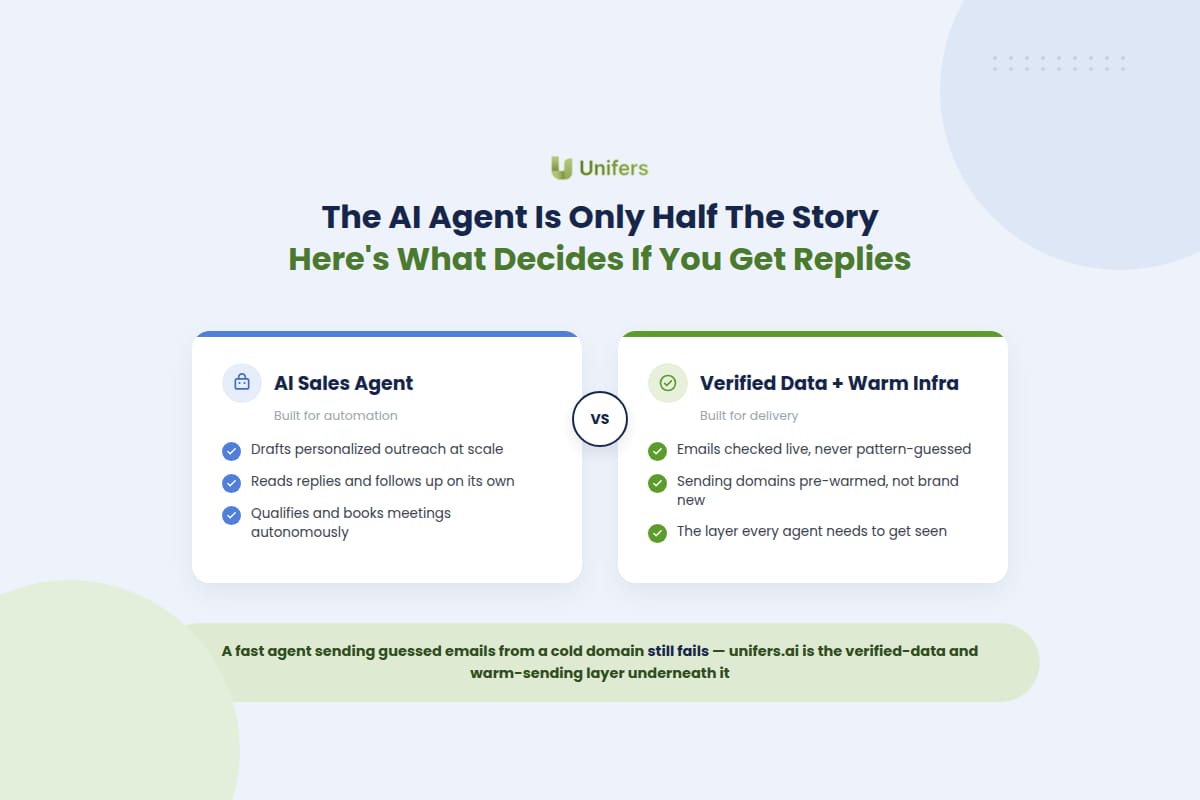
The one piece of the puzzle most comparisons of "top AI agents" miss: an agent's output is as good as the two sources underneath it - the contact data it's using, and the infrastructure it's using.
An agent that crafts a perfect, personalized message for a guessed email address still results in a bounce. An agent that schedules a perfect sequence of follow-ups from a cold, unwarmed domain gets flagged as spam before the first touch. The agent didn't fail - the data or infrastructure that fed into it did, and a faster agent just gets there quicker and at greater scale.
It's the gap most AI sales agent evaluations don't address, as it's not a feature competition - it's a set of foundational questions that come before layering an agent on top. Before adding any agent to a sales stack, two things need to be true: the contacts being reached on behalf of the user need to be verified, not pattern-guessed, and the account being used to send on their behalf needs to have a sending history an inbox provider trusts.
Where unifers.ai Fits Into an AI-Powered Outbound Stack
unifers.ai isn't an autonomous sales agent, but it is the verified-data and warm-sending layer that determines whether an agent's work actually gets seen. Search a LinkedIn profile or company, and unifers.ai returns a verified email and phone number, checked live against a database of 380M+ professionals, before it's ever passed to whatever agent or sequence the user has configured to send. Every plan includes pre-warmed sending infrastructure by default, so an account newly connected doesn't start outbound with zero trust from an inbox provider.
For a team using Clay, Artisan, or any other AI agent on top of this stack, it means the personalization and timing logic of an agent is being used on contacts and infrastructure that actually get replies.
Questions to Ask Before Choosing One
Before evaluating any AI sales agent on this list, it's worth asking a few questions first : is the current bottleneck lead volume, personalization quality, or reply follow-up, or is it that contacts and sending infrastructure weren't verified to begin with? An agent solves the first three. It can't solve the fourth on its own.
If the data and infrastructure underneath are solid, an AI agent is a great compound. If they're not, the agent just automates the same failure at a faster pace.
Get the layer every AI sales agent depends on right, with verified contacts and pre-warmed infrastructure included in every plan of unifers.ai.