- AI agent frameworks
- AI agents
- agent orchestration
- LangChain
- CrewAI
- AutoGPT
- MCP
- AI sales agent
AI Agent Frameworks in 2026: 5 Options Compared (And How to Pick One)
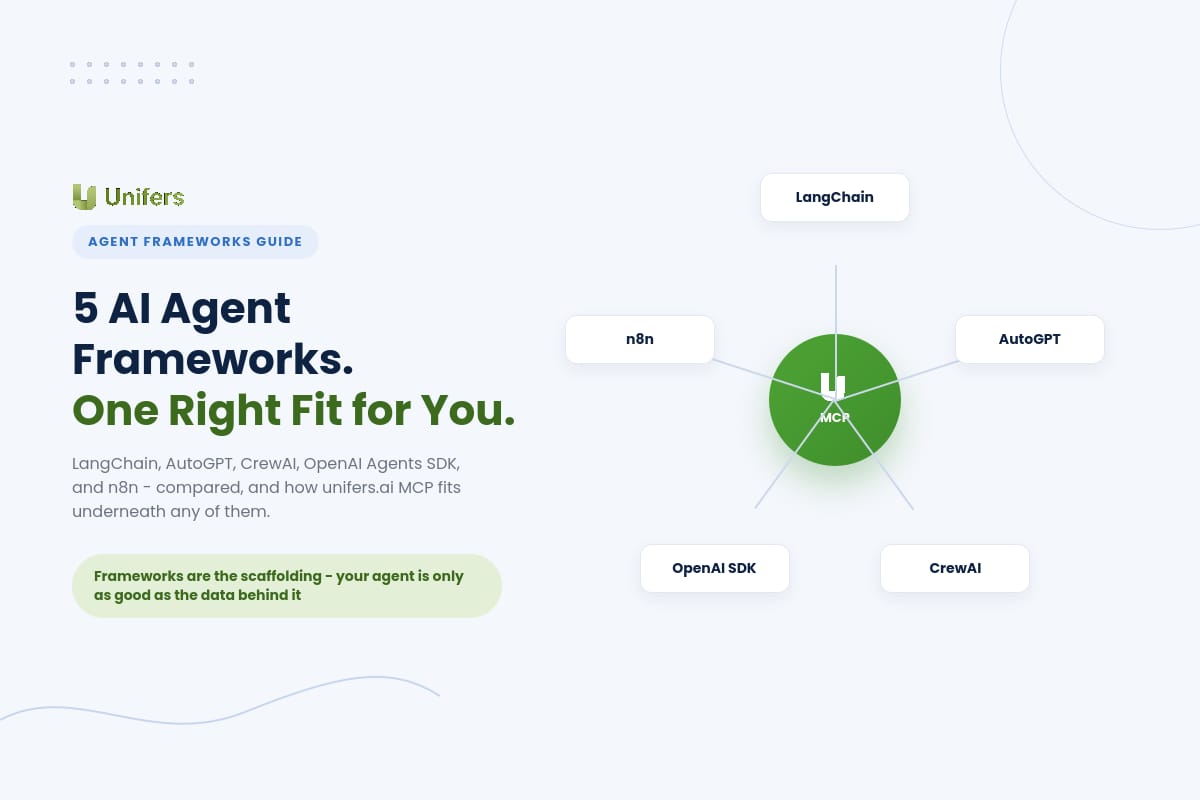
Not sure which AI agent framework to use? We break down five of the most widely adopted options - what each one does well, where it falls short, and how to choose the right one for your team and use case.
What Is an AI Agent Framework?
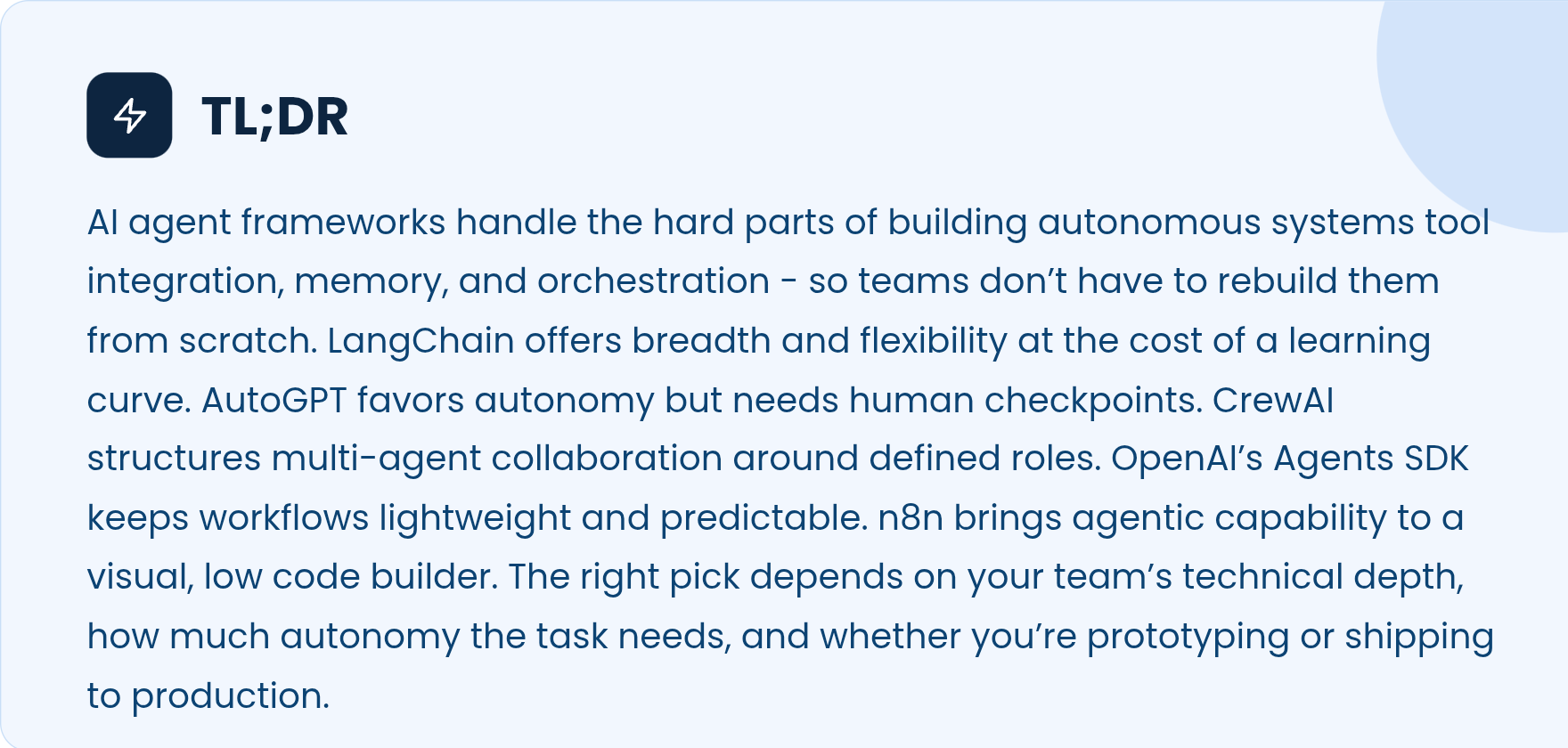
An AI agent framework encompasses sets of tools and abstractions that address common aspects of building an autonomous system that would otherwise have to be reinvented by each developer working on such a system, connecting a language model with external tools, maintaining the memory of a conversation across turns, and sequencing multi-step tasks.
Typically, such frameworks offer four main features:
An agent architecture - the way the system reasons and decides what to do next
Tool integration - connecting the model to APIs, databases, and external services
Memory management - tracking short-term context within a task and longer-term context across sessions
Orchestration logic - how tasks are broken down, sequenced, and handed off between steps or agents
While it is possible to build an agent without any of these, it is likely that the scaffolding that would need to be created for each new project will contain many of the same elements: retries, tool-calling loops, and state tracking, For Example, A framework provides developers with these scaffolding elements.
What to Look for in an AI Agent Framework
Not every framework is suitable for every use case, and the wrong choice will reveal itself in one of two ways: an overengineered setup for a simple task, or a framework that hits a wall the moment you attempt to scale.
Some points might be worth considering before choosing a framework:
The complexity of the use case: a single-purpose chatbot requires much less in terms of features than a system where multiple agents coordinate across departments.
Your team's technical depth: some frameworks presuppose a certain level of engineering knowledge; others offer a visual, low-code approach.
Integration requirements: it is crucial to look into how well the framework connects to the tools that your organisation already uses - CRMs, databases, or internal APIs. A framework that is incompatible with one's tech stack will only slow things down.
Production readiness: a framework can look great on paper but behave very differently with actual users and real-world traffic. It is important to look into the documentation, community support, and tools for logging and tracing that the framework provides.
Frameworks shorten the distance between an idea and a working prototype, but being aware of what is happening underneath the abstraction is what makes debugging and scaling manageable in the long run.
At a Glance: 5 AI Agent Frameworks Compared
A quick snapshot before the full breakdown below - what each framework is built for, where it shines, and what to watch out for.
Framework | Strengths | Watch out for |
LangChain Best for: custom, integration-heavy workflows | • 600+ integrations to connect to almost any tool • Modular components you can mix and match • Largest community and ecosystem of the five | • Real learning curve to get comfortable with • Can feel heavy for a simple, single-purpose agent |
AutoGPT Best for: autonomous, multi-step execution | • Breaks a high-level goal into subtasks on its own • Executes with minimal step-by-step prompting • Can browse, write, and run code unsupervised | • Can drift, loop, or hallucinate without oversight • Works best with human checkpoints, not hands-off |
CrewAI Best for: multiple agents on defined roles | • Beginner-friendly with a gentle learning curve • Role-based setup maps naturally to how teams work • Large course community and searchable docs | • Less flexible for fluid, less-structured decisions • Rigid if tasks don't fit neatly into fixed roles |
OpenAI Agents SDK Best for: teams already on OpenAI's stack | • Lightweight, with a small set of clear primitives • Built-in tracing for visibility into workflows • Clean handoffs between multiple agents | • Smoothest experience is inside OpenAI's ecosystem • Fewer integrations once you step outside it |
n8n Best for: visual, low-code agent building | • Drag-and-drop builder, no heavy coding required • Large library of ready-made templates • Self-hostable for teams that need that control | • Highly custom agent logic can outgrow the builder • Better suited to standard patterns than edge cases |
LangChain - Custom / integration-heavy
LangChain is one of the most popular frameworks for building LLM-powered applications, with tools for chaining prompts, memory, agent execution, and more. The ecosystem offers hundreds of integrations, meaning it can likely connect to anything in your system.
Teams leverage it to build chat assistants and recommendation systems and process documents at scale, but the breadth is valuable across both prototype and production use cases - we often see the framework used at different scales in a single company. The learning curve and maintenance overhead are steeper, though, particularly if you lack the headcount for active maintenance.
AutoGPT - Autonomy / multi-step execution
The vast majority of frameworks require defining every single step an agent must take to accomplish a task. AutoGPT replaces that process by letting the system break a broad objective into subgoals and sequence them, executing actions like browser navigation, code execution, and more.
That autonomy makes these excellent tools for agent-driven research and for any content or lead generation workflows that would be tedious to design a prompt chain for. The same benefit is also a risk - the higher the degree of autonomy, the more likely an agent is to wander, duplicate, or hallucinate. These are best implemented with thorough human checkpoints built-in, and tend to be less productive as “set-and-forget” agents.
CrewAI - Multi-agent collaboration / organisation
CrewAI adds organisation to a multi-agent architecture - each agent in a Crew has a role, and receives and produces data as part of a shared task, like a research agent feeding information into a summarisation agent. This reflects the way teams organise work in the physical world - which makes these great tools for agents that need to cooperate and share information.
It also tends to be one of the more accessible frameworks for starting out, backed by a thriving community and searchable documentation. That said, the more scripted, deterministic approach could be a disadvantage if your agent requires a lot of flexibility to adapt its behavior on the fly.
OpenAI Agents SDK - Integration with OpenAI stack
The OpenAI Agents SDK is a minimal framework centered around four main features: agents, inter-agent handoffs, input/output validation, and tracing. It builds on top of the tools available in the OpenAI ecosystem, but also works with other LLMs and has implementations for both Python and Typescript.
It fits most common agent patterns - chat assistance, content generation, code review and writing, and more. It’s a natural choice if you’re already using other OpenAI tools, but involves some rework if you’re using another backend.
n8n - Visual / low-code
n8n evolved from a general-purpose workflow automation tool into a compelling option for agent infrastructure, and exposes a visual builder instead of writing code. It connects LLMs with other tools, databases, and more - including extensive pre-built templates. It reflects a visual flow, with extensible libraries and community-sourced integrations.
Generalist teams tend to use it for lead generation and content automation - but it has broad applications. It covers most common agent automation patterns, but struggles with complex conditional logic: if your agent requires extremely deep customization beyond core behaviors, consider a code-friendly infrastructure.
How unifers.ai Fits Into the Agent Framework Ecosystem
Frameworks are the scaffolding; an agent still needs reliable data and infrastructure to operate. It's where unifers.ai exists in the stack versus competing with it - whichever framework a team builds on (LangChain, CrewAI, etc.) the agent is only as good as the contact data and inbox infrastructure it operates on.
unifers.ai ships its own MCP server and provides the chrome extension, LinkedIn contact finder, and email warmup products on top. MCP (Model Context Protocol) is the emerging standard for connecting an AI agent to external tools and data sources without custom integrations for every possible pairing (the same concept which underlies tool integration in the frameworks listed above). In practice, that means an agent which has been built on any MCP-compatible framework can call into unifers.ai directly: pull a verified email and phone number for a LinkedIn profile, check deliverability by provider, or enrich a list in bulk, as tool calls within the agent's own workflow instead of a separate manual step.
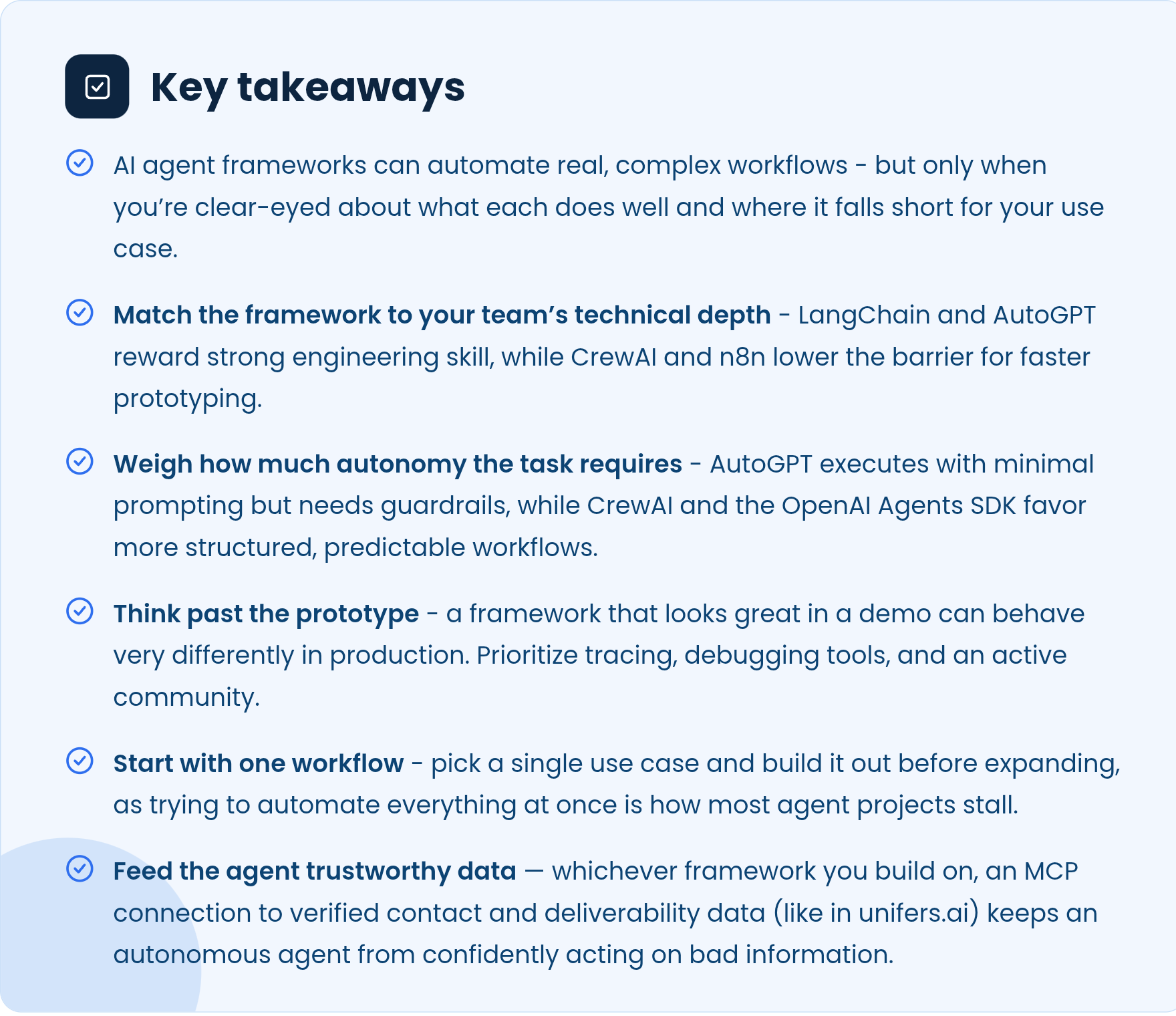
For a sales or growth team building an AI SDR or prospecting agent on any of the frameworks listed above, that distinction matters: an autonomous agent which finds a "contact" from a guessed email pattern will confidently send outreach to an address that bounces. An agent which calls into a verified contact source before it acts doesn't have that problem.
Explore how unifers.ai fits into an agent workflow at unifers.ai.