- Cold Email
- Cold Email Software
- Cold Email Strategy
- Email Deliverability
- Email Warmup
- Verified Email Finder
- LinkedIn Email Finder
Cold Email Guide 2026: How to Write & Scale B2B Outreach
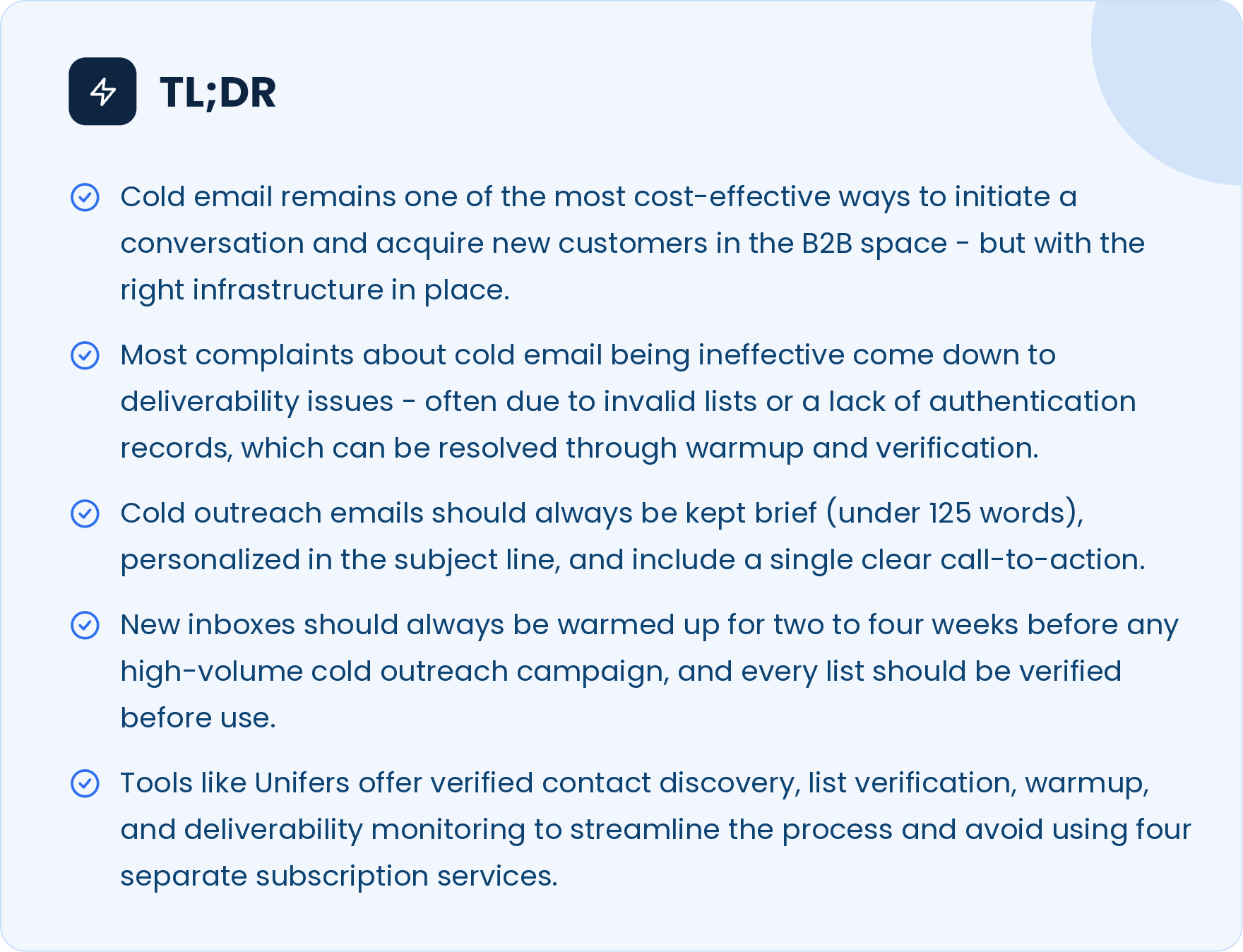
Most teams think about cold email as a copywriting challenge. It isn't, not primarily. You could be using the best subject line for your particular industry, but if your domain isn't authenticated, your list is dead 20% of the time, or your inbox hasn't been warmed up, that email never sees a human eye to evaluate your cleverly written writing for a cold email in the first place.
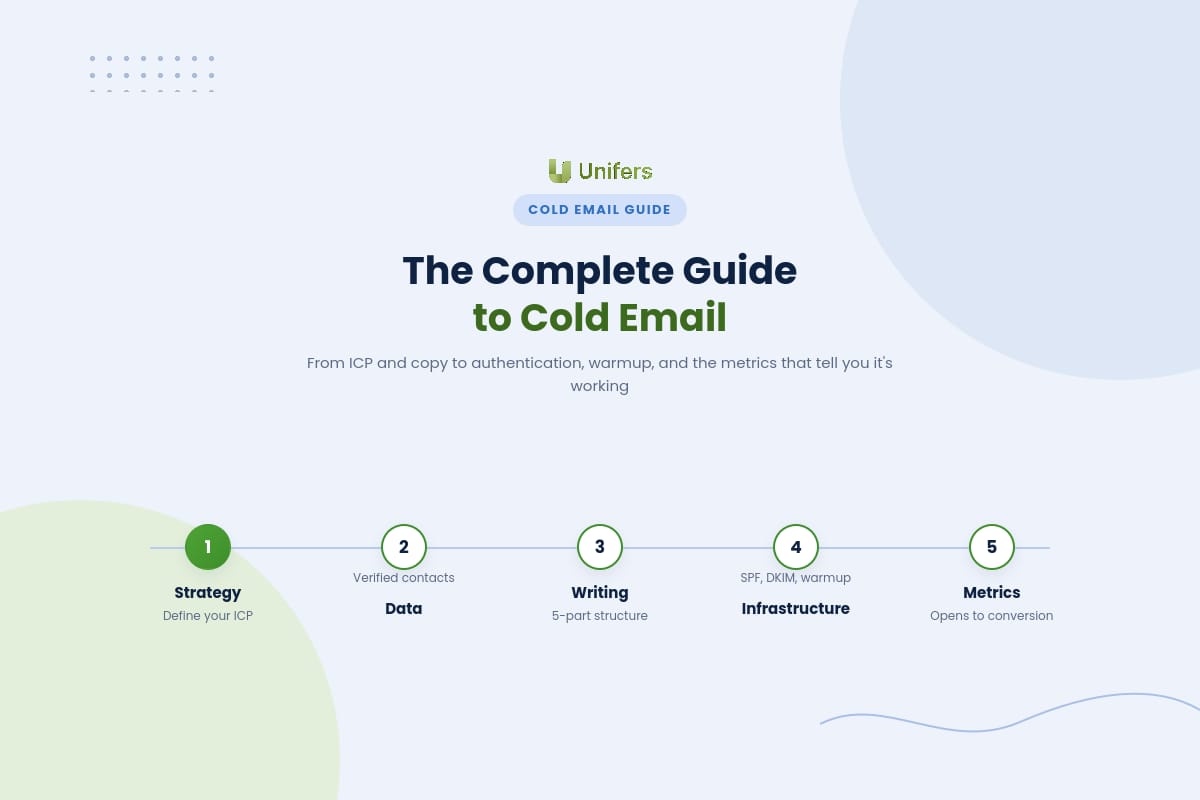
This guide walks through the whole lifecycle of a cold email program; what cold email really is, how to develop a strategy around this method of sales outreach, how to write and structure the message you wish to communicate for the best reception, and how to set up the underlying technological infrastructure that determines if any of the previous steps even matter.
What is cold Email?
Cold email is a message sent to a prospect with whom the sender did not have a relationship before, with the goal of sparking a specific business outcome (typically a reply or a meeting), with a personal tone. The ‘cold’ refers to the relationship, not the message’s tone; cold emails are meant to appear as letters from informed peers, not advertisements.
Email remains one of the few mediums in which B2B marketers can reach decision-makers directly (on their devices), multiple times, without paying for ad space or waiting until the conference hall.
Cold email vs spam - what actually separates them
The line between cold email and spam isn't about how the recipient feels when they read it — it's about targeting, personalization, and whether the message follows the law.
Factor | Cold Email | Spam |
Targeting | Built around a defined ICP and a specific recipient list | Generic, scraped, or purchased in bulk with no filtering |
Personalization | Written for the recipient's role, company, or situation | Identical template sent to everyone |
Compliance | Includes opt-out, accurate sender info, physical address | Often skips required disclosures entirely |
Sender identity | Clear, accurate "From" and "Reply-To" fields | Frequently spoofed or hidden |
Intent | Start a relevant, useful business conversation | Indiscriminate promotion, or worse |
Why B2B Teams Love Using Cold Email
Cold email has better cost per lead than paid channels of lead generation since there is no auction to bid in and spend money on in order to get a lead. You just write the email, make sure your list is accurate, and send – it only costs the tool and your time.
Moreover, the channel has the virtue of providing you with hard metrics. Open rates, reply rates, and click-throughs will tell you if something works or not in just a couple of days, whereas a trade show or a cold calling campaign will take weeks to see any ROI.
What makes cold email programs of some teams significantly outperform others? Mostly it is not creativity, but the strict targeting and sender reputation management and list hygiene that help get more replies. Teams that have processes in place to segment their audiences and make sure they deliver relevant messages to well-qualified recipients beat the competition.
Building a Cold Email Strategy That Converts
Before writing a single subject line, answer three questions: who exactly you're targeting, where the contact data is sourcing from, and what a successful outcome looks like in numbers. Skipping any of the three usually means guessing, and guessing is what burns domains.
Define Your Ideal Customer Profile (ICP)
Your ICP is the particular type of company and buyer that has the highest likelihood of converting and staying a customer instead of being a one-time deal - not a general description of anyone who could be interested. A narrower ICP typically results in a higher reply rate than a broader one, because the message has a chance to speak at a specific, recognizable pain point.
Study your best existing customers. Look at who converted fastest and stayed the longest, and find what they have in common.
Define firmographics: industry, company size, revenue range, geography, growth stage.
Define the buyer: job title, seniority, pain point they specifically own.
Identify buying triggers: a recent hire, a funding round, a new market entry, or a tool change.
Test the ICP against a small list before expanding to a campaign.
Source Verified Contact Data
List quality determines your bounce rate before the first email even leaves. A contact list with a significant percentage of invalid addresses can severely damage your sender reputation within days, and once that reputation is burned, every future launch of any kind from that domain is in trouble.
Verify before you upload: run every contact through a real-time verification step, not only a format check, before it goes into a live sequence. A LinkedIn email finder or verified email finder tool can confirm a contact exists before you spend a send on them.
Enrich in bulk: instead of researching one prospect at a time, pull entire, verified profiles, including email, phone, and company, from a LinkedIn URL or a partial lead.
Maintain suppression lists: once someone has opted out, they will never be contacted in a future campaign, on any list.
Re-verify stale lists: a list built six months ago is not the list you should be sending to today. People change roles and emails constantly.
How to Write a Cold Email That Gets Replied To
Every piece of a cold email should do one of two things: get opened or get replied to. Anything that doesn't serve one of these two uses is worth cutting.
The Five-Part Structure
Subject line - reference a specific situation or outcome relevant to this recipient. Generic lines get ignored; specific ones earn the open.
Opening line - one sentence, entirely about the recipient. Reference something real: a recent hire, an announcement, a challenge common to their role.
Value proposition - lead with the problem, rather than your solution. Briefly describe the problem in 1 sentence and what outcome you help deliver.
Call to action - a request for a single action. "Worth a quick look?" outperforms "Book a 30-minute demo on my calendar." use 1 CTA.
Signature - include your full name, title, company, and any tools to help them verify you are who you say you are. (This is crucial for compliance reasons).
A Simple Cold Email Template
Subject: [Company name] + [specific problem]
Hi [First name],
I noticed [Company name] recently [specific trigger — expanded into a new market, hired a VP of X, launched Y]. Teams in that position often run into [specific bottleneck] in the first few months.
We've helped teams like [similar company type] work through that without adding headcount.
Worth 15 minutes to see if it's relevant to you?
[Your name]
Designing Cold Email Sequences and Follow-Ups
A single email campaign rarely converts a prospect on its own — a large majority of conversions happen on subsequent follow-ups, not the initial cold email. That means that if you send a single cold email and stop there, you're missing out on a huge amount of potential conversions.
4-7 emails is a good range for most B2B cold email sequences. At minimum, each follow-up email should include a new value proposition or ask - never repeat the same CTA or value proposition in a follow-up email.
Touch | Typical Timing | Purpose |
Email 1 | Day 0 | Introduce the problem and a specific, relevant trigger |
Email 2 | Day 2–3 | Add a new angle or a short proof point |
Email 3 | Day 5–7 | Share a resource, case example, or short story |
Email 4 | Day 10–14 | Lighter, lower-friction ask |
Email 5 | Day 18–21 | Final, low-pressure check-in or breakup email |
Keep sequences to around five touches. Beyond that, spam complaint rates tend to rise faster than reply rates, which works against the sender reputation you're trying to build.
Where cold email campaigns go wrong
Common pitfalls -
Emails are going to spam – either the domain wasn’t warmed up properly or the daily sending limit for the new domain was exceeded.
No reply rate increase - it usually means that there is an issue with targeting (ICP was too broad) or with the email itself (too long, not clear call to action) and not that you simply need to send more emails
Domain reputation decrease - happens when inboxes aren’t rotated and monitored properly and one campaign with a bad inbox list ruined the domain’s reputation for other campaigns.
High bounce rate - because data wasn’t cleansed and validated before sending.
Setting Up Your Cold Email Infrastructure
Infrastructure is the hidden part of cold email, which is determined not to miss a single opportunity to get your letter opened by the recipient. The reason for deliverability issues in copy is often not the subject line itself, but rather authentication or a skipped warmup period.
Authentication: SPF, DKIM, and DMARC
The sending domain requires three DNS records to be set up before the first campaign launch:
SPF(Sender Policy Framework): an SPF record published in the DNS zone of the sending domain announces to the receiving server which mail servers are authorized to send letters on behalf of the domain.
DKIM(DomainKeys Identified Mail): DKIM adds an encrypted signature to the header of each message, verifying that the letter actually came from the specified domain without any alterations.
DMARC(Domain-based Message Authentication, Reporting & Conformance): This record describes what action should be taken with messages that fail SPF or DKIM checks and reports statistics on failed deliveries.
Most of the world's largest inbox providers now require all three records to be correctly set for each domain that sends regular campaigns. With incorrect authentication, not only will your letters not get past the spam filter, but all subsequent letters from this domain may be perceived with suspicion.
Domain and Inbox Warmup
The first letters from a new domain or inbox require a warmup period to reach the desired volume and frequency of delivery. A warmup tool(Unifers ) communicates with selected inboxes on behalf of the sender's domain, gradually increasing the number of letters in volume and frequency to avoid suspicion and allow the domain to develop a good reputation in the inbox. As a rule, it is advisable to carry out a warmup for two months for a new domain or a long-idle inbox before launching the main campaign. It is advisable to start with a small quantity of letters per day and gradually bring the volume to the desired value.
Measuring Cold Email Performance
A few key metrics should be monitored and analyzed to evaluate how cold emailing efforts are performing and what changes need to be made.
Metric | What a healthy range looks like | If it's low, check |
Open rate | Roughly 25–45% | Subject line relevance, sender name, list targeting |
Reply rate | 5%+ is solid; 10%+ is strong | Personalization, ICP fit, CTA clarity |
Bounce rate | Under 2% | List verification before send |
Conversion rate | Varies widely by offer and industry | ICP tightness, offer clarity, sequence structure |
If your numbers fall well below these ranges across multiple campaigns, the underlying issue is almost always infrastructure or targeting - not the writing itself.
Cold Email Compliance: What to Know
Cold email is a legal practice which is regulated in most jurisdictions. The two most relevant frameworks for B2B emailers are CAN-SPAM in the United States and GDPR in the European Union.
CAN-SPAM (US): requires accurate sender information, unambiguous subject line which reflects the content of the message, a valid physical address, and a functional opt-out mechanism which is honored promptly.
GDPR (EU): allows B2B email outreach as long as there is a legitimate reason to contact the prospect (business to business), personal data is limited to what is strictly necessary for communication, and an opt-out mechanism is provided.
In most cases, neither of the laws requires prior consent to send a cold email, as long as the message is relevant to the recipient and the sender has exhausted other, more appropriate, methods of outreach. However, both laws require emailers to refrain from using misleading information and provide a clear way for the recipient to stop receiving communication. As a rule of thumb, it is better to err on the side of caution and assume that cold email outreach always requires consent, even if it is not explicitly stated. In practice, emailers who comply with the spirit of the law and use personalized, relevant, and opt-out friendly messages to contacts who have expressed interest in the product or service, do not face any issues.
Choosing the Right Cold Email Tools
A complete cold emailing solution consists of four interrelated features. Most emailers use a combination of different tools to achieve their goals, but a fragmented approach usually results in billing and authorization issues. A single user will have to log in and out of multiple services to send a campaign, which increases the risk of error.
Verified contact discovery: finding and verifying email addresses and phone numbers of a prospect which have been discovered via LinkedIn or another source, using a LinkedIn email finder or similar tools. This stage is crucial to avoid using static, purchased databases which contain outdated or fake information.
List verification: checking individual addresses in real time to ensure deliverability before adding them to a suppression list
Sending and sequencing: scheduling and sending cold emails in a logical sequence, as well as managing replies in one interface.
Warmup and deliverability monitoring: building sender reputation and monitoring for authentication and deliverability issues.
Unifers.ai takes a consolidated approach to cold email management, providing verified prospect discovery, bulk list enrichment, targeted segmentation, and sequencing tools, as well as warmup and monitoring functionality. With Unifers, an emailer does not need to subscribe to multiple services to maintain a functional cold email outreach operation. All relevant tasks can be accomplished within a single interface with no additional costs.
The Bottom Line
Cold email as a channel benefits enormously from a systemic approach to outreach. Maintaining a good sender reputation is paramount, which means limiting the volume of messages sent to any one inbox. Sending relevant messages to a well-defined ICP (ideal customer profile) using verified data is also important, as is providing a functional opt-out mechanism and complying with the regulatory framework. Finally, the actual content of the cold email should be optimized, but only after the email has been successfully delivered to the intended inbox.