- AI Prospecting
- AI Prospecting Tools
- B2B Lead Generation
- AI Sales Assistant
AI Prospecting Tools: The Complete Guide to Finding Better B2B Leads in 2026
Finding the right prospect shouldn't be hours of searching, filtering, copying/pasting and switching between tabs
But for many sales teams, this is what prospecting looks like.
Open LinkedIn. Search for companies. Filter by job title. Check if they still work there. Find an email address, look for a phone number. Research the company. Add it all into a spreadsheet. All of it is repeated for the next 100 prospects.
By the time the list is ready, half of the information may already be out of date.
This is where AI prospecting tools are transforming the way B2B sales teams are building pipelines.
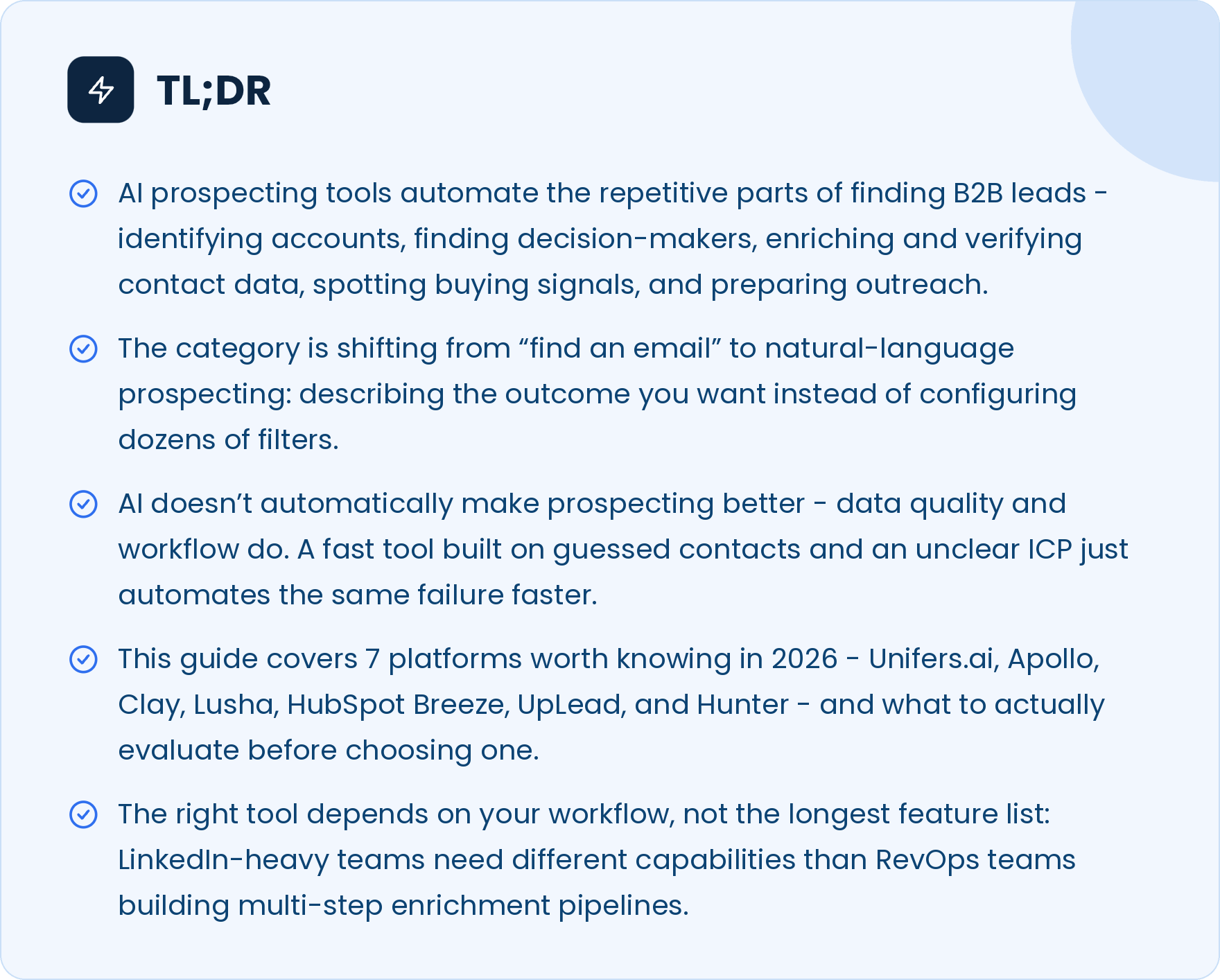
Rather than relying completely on human research, AI can help teams identify accounts, find the right decision-makers, enrich contact data, identify buying signals, prioritize and prepare outreach.
But there is an important caveat.
AI doesn't automatically make prospecting better. Better data and better workflows do.
So what exactly are AI prospecting tools, how do they work, and what tools are worth considering in 2026?
Let's dive in.
What Are AI Prospecting Tools?
AI prospecting tools are sales and lead-generation platforms that utilize AI to automate or accelerate the prospecting process.
Traditional prospecting often relies on manually searching databases, LinkedIn profiles, company websites, spreadsheets, and CRM records.
AI prospecting fundamentally changes the prospecting workflow by enabling AI to take over a lot of the repetitive research.
Depending on the platform, an AI prospecting tool can help you
Find companies fitting your ideal customer profile
Identify decision-makers
Enrich existing contact records
Research companies/prospects
Identify buying or intent signals
Score / prioritize leads
Help with personalized outreach
Automate parts of the sales workflow
Modern platforms are increasingly shifting towards natural-language prospecting, where users can describe the prospects they want rather than having to manually configure dozens of filters.
For example:
Find SaaS companies in the US with 50-500 employees that recently hired a VP of Sales.
The goal isn't to generate a bigger list.
It's to generate a more relevant list with less manual effort.
Why Are AI Prospecting Tools Becoming So Popular?
The issue with traditional prospecting isn't that sales teams don't have data. It's that they have too much data and less time to work with.
A salesperson might have thousands of companies in a CRM but spend hours trying to answer basic questions such as:
Who should I contact?
Does this person still work there?
Are they involved in the buying decision?
What is their current role?
How can I contact them?
Why would they care what I'm selling?
AI can help reduce the amount of manual research required to answer these questions.
And that's where the market is shifting.
Clay, for example, is now positioning AI prospecting around finding accounts, enriching contacts and identifying relevant information and generating personalized outreach.
Lusha similarly describes AI prospecting as a combination of account discovery, contact enrichment, buying signals and outreach preparation rather than simply automated emailing.
The important takeaway is that AI prospecting is moving towards being less about "finding emails" and more about understanding who to contact, why now, and what to say.
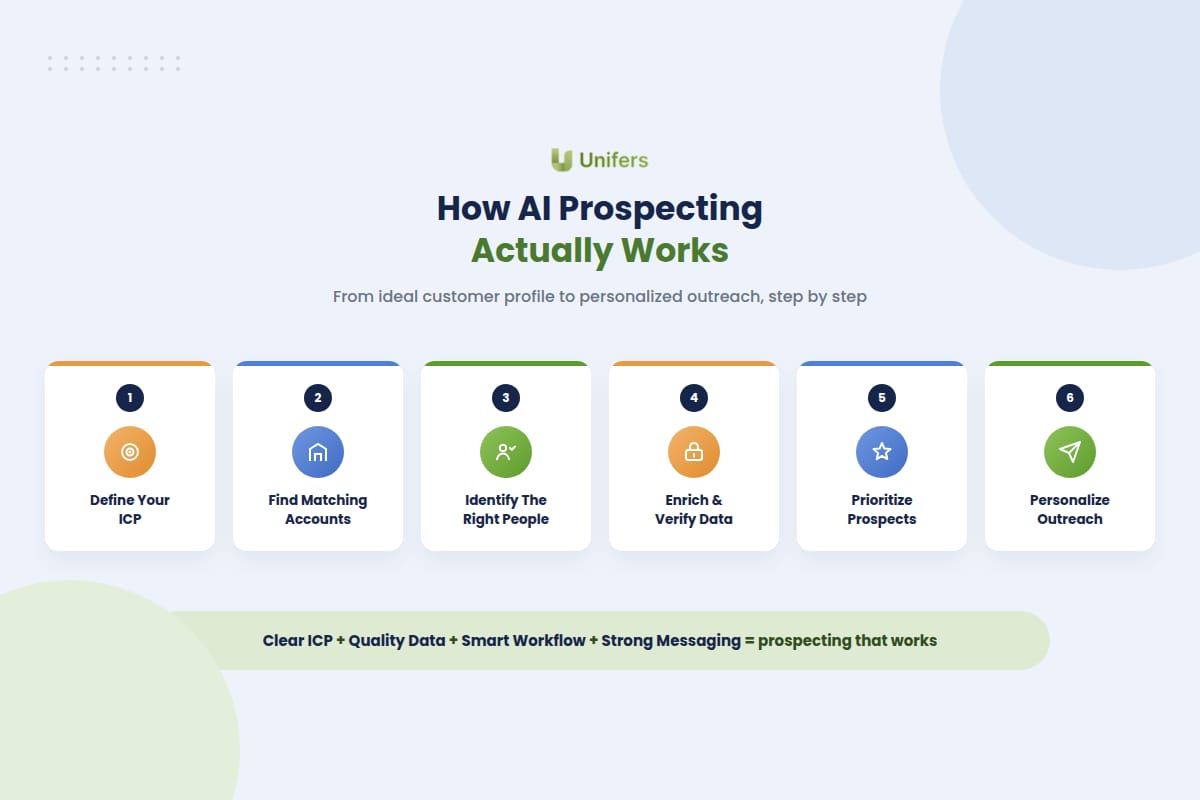
How Do AI Prospecting Tools Work?
Although different platforms work differently, most AI prospecting workflows follow a similar pattern.
Define Your Ideal Customer
Tell the platform what a good prospect looks like.
For example:
Industry : SaaS
Company size : 50-500 employees
Location : United States
Job title : VP Sales / CRO
Growth stage : Series A-C
This becomes your Ideal Customer Profile (ICP).
Find Matching Accounts
The platform will search its available data sources to identify companies that fit your ICP.
Some tools leverage primarily their own databases.
Others combine multiple data providers to improve coverage.
Clay, for example, uses multiple data sources and waterfall enrichment to improve the chances of finding relevant information.
Identify The Right People
Finding the company is only the beginning. AI prospecting tools can help identify people who may have an influence or make the buying decision.
Rather than searching:
SaaS companies
You can move towards:
VPs of Sales at growing SaaS companies.
A much more relevant prospecting criterion.
Enrich The Contact
Next comes filling in the missing information, such as:
Work email
Phone number
Job title
Company
Location
Industry
Company size
Professional background
Technology information
This process is generally referred to as B2B data enrichment.
Verify The Data
This step is often overlooked but is critical.
AI can help you find a prospect, but if the underlying contact information is incorrect, your beautiful automated workflow can come crashing down.
Data quality should be one of the first considerations when choosing an AI prospecting tool.
Unifers.ai , for example, positions their LinkedIn Contact Finder around verified business emails and direct phone numbers, with real-time email validation before contact information is displayed.
Prioritize Prospects
Not all prospects are equal, and not all should receive the same amount of attention.
AI can help prioritize based on information such as:
Company characteristics
Job role
Buying signals
Recent company activity
Technology adoption
Hiring activity
Previous customer patterns
The objective is simple: spend more time on prospects who are likely to become customers.
Personalize Outreach
Once the prospect is identified and researched, AI can help prepare relevant messaging.
But there's an important caveat: personalization doesn't mean copying someone's LinkedIn bio into an email.
Good personalization means connecting a real observation to a relevant business problem. Bad personalization just creates longer emails.
7 Best AI Prospecting Tools to Consider in 2026
There isn't one "best" AI prospecting tool for every team. The right choice depends on your workflow, data needs, budget, CRM, geography, and level of automation.
Here are some of the major categories and platforms worth evaluating.
Unifers.ai
Best for : LinkedIn contact discovery, verified contact data and prospect enrichment.
Unifers.ai is especially relevant for teams that invest a significant amount of time prospecting on LinkedIn.
Its LinkedIn Contact Finder can uncover verified business emails and direct phone numbers while users browse LinkedIn or Sales Navigator. It also supports bulk enrichment and waterfall enrichment for international contacts.
Unifers.ai is also expanding into AI-connected workflows through its MCP server, which can let compatible AI assistants search profiles, retrieve contact details, and interact with campaigns from a conversation.
Best fit : Sales reps, founders, recruiters and prospecting teams that want contact discovery and enrichment closely tied to their workflow.
Apollo
Best for : All-in-one prospecting and sales engagement.
Apollo combines contact discovery, prospecting, enrichment, and outreach automation in one platform.
It is useful for teams that want a broader sales engagement system rather than a dedicated contact-finding workflow.
Best fit : Sales teams seeking prospecting + outreach in one platform.
Clay
Best for : Advanced data enrichment and automated GTM workflows.
Clay is especially strong for prospecting scenarios that involve multiple data sources, enrichment steps, and complex workflows.
Its content strategy similarly reflects this positioning: rather than just publishing product announcements, Clay focuses on creating detailed playbooks around AI prospecting, outbound sales, enrichment, account research, and GTM engineering.
Best fit : RevOps, growth and GTM teams building sophisticated prospecting workflows.
Lusha
Best for : B2B contact data, prospecting and buying signals.
Lusha has been positioning itself around AI-powered prospecting, intent signals, and automated prospect discovery.
Its current content strategy emphasizes a shift from static databases to identifying prospects based on timing and buying signals.
Best fit : Sales and marketing teams seeking contact data plus prospecting intelligence.
HubSpot Breeze
Best for : Teams already using HubSpot.
HubSpot's AI prospecting capabilities are closely tied to its CRM.
Its Prospecting Agent is designed to identify prospects, enrich, and move them into sales workflows without requiring as much manual data movement between systems.
Best fit : Companies already running their sales process through HubSpot.
UpLead
Best for : B2B contact data and list building.
UpLead focuses heavily on contact data, lead generation, and verification.
Its content strategy is especially strong around commercial search intent, with pages targeting competitor alternatives, pricing searches, and "best tools" queries.
Best fit : Teams primarily seeking B2B contact data and lead lists.
Hunter
Best for : Email finding and email verification.
Hunter is well known for email discovery and verification.
Best fit : Teams whose primary need is finding and verifying professional email addresses rather than managing an entire prospecting workflow.
AI Prospecting Tools: What Should You Actually Look For?
A long feature list doesn't always mean a better prospecting platform. Before choosing a tool, evaluate it against the issues your sales team actually has.
Data Accuracy
This should be the first consideration on your list.
Ask yourself:
How frequently is contact information updated?
How are phone numbers sourced?
What happens when data is incorrect?
AI is only as good as the information it works with.
Contact Coverage
A big database can still miss the people you need.
Look at:
Geographic coverage
Industries
Job functions
Seniority levels
Company sizes
Phone coverage
Email coverage
LinkedIn Integration
If your team already uses LinkedIn or Sales Navigator for prospect research, this can make a big difference.
A workflow that looks like:
LinkedIn → find prospect → retrieve contact → enrich → CRM
Is much more efficient than:
LinkedIn → copy name → Google → company website → spreadsheet → email finder → verification → CRM.
AI Research Capabilities
Ask what the AI actually does.
Does it only write emails?
Or can it also:
Find prospects?
Research accounts?
Identify decision-makers?
Detecting signals?
Enrich records?
Score leads?
Create workflows?
The second category is where AI prospecting can become much more valuable.
CRM Integration
Your prospecting tool shouldn't create another data silo.
Check if it integrates with your CRM and whether enriched information can flow back without repetitive manual exports.
Human Review
Automation doesn't mean eliminating humans from the process.
The best workflow is often:
AI researches → AI enriches → AI prioritizes → human reviews → human engages.
That way, you get the speed of AI without blindly trusting everything an AI tool outputs.
AI Prospecting vs Traditional Prospecting
Traditional prospecting | AI prospecting |
Manual searches | AI assisted discovery |
Static lists | Dynamic prospect lists |
Spreadsheet research | Automated enrichment |
Manual Qualification | AI assisted prioritization |
Guessing contact information | Verified contact data |
Data informed personalization | |
Connected workflows | |
More administrative work | More selling time |
But this doesn't mean traditional prospecting is obsolete. The real advantage is not eliminating salespeople. It's reducing repetitive work, so they can spend more time building relationships, understanding problems, and having meaningful conversations.
What Are the Benefits of AI Prospecting?
When implemented properly, AI prospecting can help sales teams:
Save Research Time : Automate repetitive data collection and account research.
Build Better Prospect Lists : Use ICP criteria and enrichment to identify more relevant contacts.
Improve Data Quality : Verification and enrichment can reduce outdated or incomplete records.
Scale Personalization : AI can analyze prospect information faster than a salesperson researching every account.
Prioritize Better Opportunities : Signals and scoring can help prioritize which prospects deserve attention.
Create Repeatable Workflows : Rather than each salesperson developing their research process, teams can standardize how prospecting is handled.
What AI Prospecting Can't Fix
AI isn't a magic button. If your ICP is unclear, AI can just help you find the wrong people faster. If your data is bad, AI can automate poor-quality prospecting. If your offer isn't compelling, personalization won't fix that. And if your outreach is weak, sending more messages won't necessarily create more customers.
A successful AI prospecting system needs four things:
Clear ICP + Quality Data + Smart Workflow + Strong Messaging
Remove any one of these, and it becomes less effective.
The Future of AI Prospecting
The next generation of prospecting tools won't just be databases with an AI button attached. They'll increasingly behave more like AI sales assistants.
Rather than manually searching:
"Find companies matching these 10 filters."
You'll be able to describe the outcome you want:
"Find companies that look like our five best customers, identify the decision-makers, enrich their contact details, and prepare a prioritized list for today's outreach."
AI handles the research; the team handles the relationship. That's where the market is already shifting.
Clay is connecting its data and workflows with AI interfaces such as ChatGPT and Claude, while Lusha is developing natural-language prospecting and AI-connected workflows.
Final Thoughts: The Best AI Prospecting Tool Is the One That Fits Your Workflow
AI prospecting isn't about finding the tool with the longest feature list. It's about finding the tool that reduces the most friction in your prospecting process.
If your biggest problem is:
Finding verified contacts - choose a strong contact discovery and enrichment platform.
Building complex enrichment workflows - look for advanced data orchestration.
Managing CRM-based prospecting - consider an AI system deeply integrated with your CRM.
Finding prospects on LinkedIn - prioritize LinkedIn-native contact discovery.
Automating the entire sales process - look for a broader sales engagement platform.
The important thing is to start with the workflow, not the software. Because the goal of AI prospecting is not to find more contacts; it's to find the right people, with the right information, at the right time.
And when the data is accurate and the workflow is connected, your sales team can spend less time searching and more time selling.
For more facts and comparisons, explore unifers.ai