- Lemlist alternatives
- email outreach
- cold email
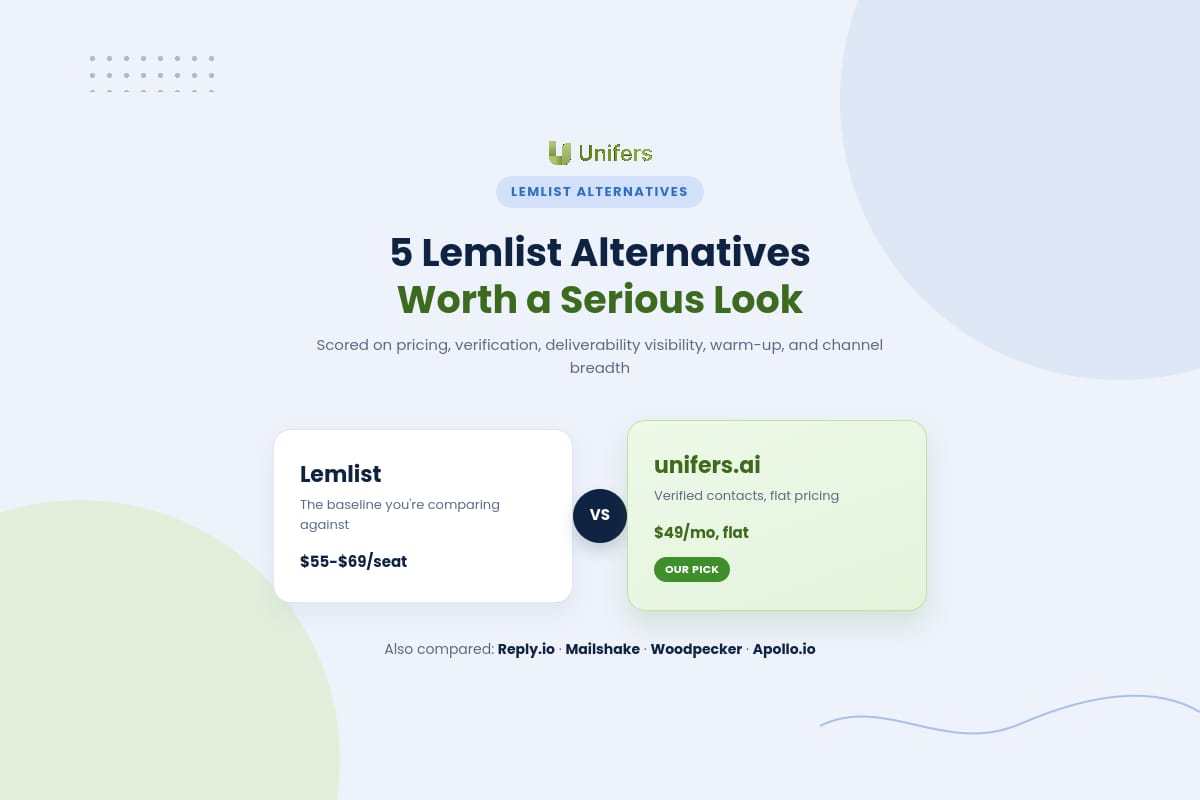
I Checked 5 Lemlist Alternatives - Here's the One You Should Use
You're likely to be here for one of three reasons -
Your Lemlist bill just jumped after adding a few teammates and per-seat pricing isn't looking so great for your team size
Your deliverability has tanked and multichannel, image-heavy campaigns are making it hard to determine whether the issue is your domain or your creative
Or, you're evaluating cold outreach platforms for the first time, and want to have an idea of what's out there before committing to one.
Two disclosures before we begin.
One, we've built one of the alternatives on this list (unifers.ai) and are not pretending to be entirely impartial here
Two, we will tell you when Lemlist is objectively the better option (there are some use cases), and name them.
If that floats your boat, let's get into it.
How We Evaluated These Tools
We scored each tool on 6 criteria:
Pricing model (per-seat vs flat) and what it costs at 3, 10, and 25 users
Contact verification (real-time or bounce risk on you?)
Deliverability visibility (one blended reputation score or separated by provider?)
Warm-up (included by default, bundled per seat, or separate purchase?)
Channel breadth (email only, or native LinkedIn and call steps included?)
Ease of setup (time to first campaign, and % of creative tooling that requires design work before sending)
Quick Comparison: 5 Lemlist Alternatives at a Glance
Lemlist sits at the top as the baseline you're comparing against. The alternatives are below it.
Tool | Entry price | Pricing model |
Lemlist - Baseline | $55–$69/seat | Per seat |
unifers.ai - Our pick | $49/mo | Flat, unlimited seats |
$59/user (annual) | Per user | |
Mailshake | ~$29/mo | Per seat |
Woodpecker | ~$29–$59/mo | Per active contact/seat |
$49/user (annual) | Per seat |
Where Lemlist Still Wins, and Three Signs You've Outgrown It
Before the alternatives: if you're reading this, you're likely either on or considering Lemlist. Pretending it's a bad tool would be a lie. Pretending it will scale infinitely for every team is also a lie.
Here's where Lemlist does well, and when it's time to move.
Where Lemlist Is Still the Right Pick
Lemlist does one thing particularly well, and for the right buyer it's the only thing that matters: creative, multichannel personalization. Dynamic images, video embeds, custom landing pages and LinkedIn touches woven into the sequence as email create visibly distinct outreach that plain-text tools can't match. For small teams selling into narrow ICPs where a memorable, high-touch email makes a noticeable difference in the reply rate, that differentiation earns its cost.
Lemwarm, bundled free into every seat, is also a real convenience -- warm-up doesn't require an additional purchase or setup step, it just comes with the seat you're already paying for.
Three Signs You've Outgrown It
Your team grew past 3-4 seats and the per-seat bill (now $200-400+/month before add-ons) no longer tracks with how much you're actually sending.
Your outreach is email-first, and you're paying for multichannel and creative infrastructure (LinkedIn steps, video personalization) you rarely use.
You need to know what mailbox provider is filtering your mail specifically, and not a blended open/reply number -- Lemlist's reporting doesn't break this out.
If none of these are you, stay on Lemlist. This article won't change that. When one or more are, here are five alternatives worth a serious look.
Unifers.ai
We won't pretend to be neutral. We built unifers.ai. Here's what we actually do, what we do best, and where we fall short.
unifers.ai is built around a specific bet: most outbound campaigns fail before the copy even matters, because the contact wasn't real, the sender had no visibility into where the email actually landed, or the inbox wasn't warmed up yet. Rather than bundling in every channel Lemlist supports, unifers.ai focuses tightly on three things -- verified contacts, per-provider deliverability visibility, and ready-to-send infrastructure -- all under one flat price.
What unifers.ai Does Best
The contact layer is the real differentiator - a Chrome extension reveals a verified email and direct phone number on a LinkedIn profile or inside Sales Navigator, with unlimited US lookups and waterfall enrichment abroad across a database of 380M+ contacts. Verification happens in real-time at the point of contact -- if an email can't be verified, you're not charged for it, which is a meaningfully different guarantee than a finder who charges per-credit regardless of accuracy.
The deliverability layer is the other half of the bet. Rather than one blended reputation score, unifers.ai reports inbox placement, bounce rate, and spam rate broken out per provider, and rotates sending volume automatically across every connected mailbox so no single inbox bears the load. Every plan also includes pre-warmed infrastructure standards, so there's no multi-week ramp before a new campaign can launch.
Where unifers.ai Loses
Channel breadth is the honest trade-off. unifers.ai is email-first; its LinkedIn integration finds and verifies contacts but isn't a channel you send automated LinkedIn messages or calls through inside a sequence the way Lemlist or Reply.io do. If multichannel sequencing is core to how your team sells, that's a gap, not a pricing quirk.
Creative personalization is the other gap. unifers.ai supports standard variable-based personalization; it doesn't have Lemlist's image or video generation tooling built in. For teams whose reply rate depends on this kind of visual differentiation, Lemlist still does it better.
unifers.ai Pricing
Free trial for 7 days is available, no credit card required.
Starter - $49/mo: 5,000 uploaded contacts, 10,000 emails/month, access to 380M+ contacts.
Growth - $79/mo: 10 email warm-ups, API access, 50,000 uploaded contacts, 100,000 emails/month.
Pro Unlimited - $149/mo: unlimited warm-up (up to 50 accounts), 200,000 emails/month.
Flat, regardless of team size - a team of five costs the same as a team of one.
Reply.io
Reply.io is the closest multichannel competitor to Lemlist if their specific creative tools aren't the draw but the multichannel sequencing is the goal. It strings email, LinkedIn, SMS, and calls into one sequence, with AI-assisted send-time optimization and built-in meeting booking. The Multichannel plan runs roughly $59-$99 per user per month depending on tier, so the per-seat math is similar to Lemlist's -- a 5 person team lands somewhere around $300-$500/month before add-ons. It's a reasonable middle ground for teams that want true multichannel but find Lemlist's creative heavy tooling like more than they need.
Mailshake
Mailshake is the simplest tool on this list, and it's priced like it -- around $29/month with a clean drag-and-drop builder, a built-in phone dialer for follow-ups, and straightforward A/B testing on subject lines. There's real appeal here for a team that wants to be sending within the hour and doesn't need deep contact verification or multichannel sequencing. The trade-off shows up later -- minimal deliverability reporting and no real contact-finding layer mean the list quality and inbox health are entirely on you to manage elsewhere.
Woodpecker
Woodpecker is the compliance-first pick. GDPR handling, automatic bounce and unsubscribe management, and detailed audit trails are built in rather than bolted on, which makes it the natural choice for regulated industries or EU-heavy outreach where a compliance misstep is a real business risk, not just an annoyance. Pricing runs on active contacts rather than a flat seat count, which keeps small campaigns cheap but means cost tracks list size rather than team size -- worth checking against your own volume before committing.
Apollo.io
Apollo is a data product first and a sending tool second. If "we can't find the right people to email" is the actual bottleneck, Apollo's 210M+ contact database and filter depth (intent signals, job-change triggers, technographic data) outmatches every other tool on this list, including Lemlist's own database. Where it gets expensive is trying to run high volume through it -- Apollo's sequencing was built around SDR-style targeted outreach, not agency-scale volume, and running email at real scale across a five person team on the Professional plan ($49-$79/user/month annual) adds up fast once you're also paying for the data. Teams that need Apollo's data depth often pair it with a dedicated flat-fee sender rather than running everything through Apollo alone.
unifers.ai vs Lemlist: The Head-to-Head
Both are viable. Past that, the gap is real, in both directions. Here's the criterion-by-criterion comparison.
Pricing at Scale
The comparison only matters at the point where you're past a number of seats equal to one. Lemlist's Email Pro costs $55-$69 per user per month; a team of five would be at $275-$345/month before considering extras like Multichannel Expert, which drives that number up to $395-$495/month. unifers.ai's pricing is flat, not scaling with the number of seats at all; Pro Unlimited for $149/month covers five people (or fifty) with unlimited number of warm-up included. The breakeven point is almost immediate: past about two or three seats, unifers.ai is already cheaper and the gap only widens past that.
Contact Data
Lemlist's email finder is at about 80% accuracy on a 600M+ contact database. It's useful, but it means that about one out of every five contacts you pull from there will need double-checking before you can rely on them. unifers.ai verifies in real-time at the point of contact and doesn't charge for anything that fails verification, shifting the risk from your bounce rate to the tool.
Deliverability Infrastructure
This is where the two products actually take an opposite stance to one another. Lemlist reports opens, replies, and basic bounce data as a blended view per campaign. unifers.ai reports inbox placement, bounce rate, and spam rate broken out per mailbox provider, so a domain that's landing fine in Outlook but getting filtered in Gmail is visible as such.
Warm-Up
Both handle this well, from opposite angles. Lemlist's lemwarm is free with every paid seat, which is convenient once you're already paying for the seat. unifers.ai includes pre-warmed infrastructure standards on every plan, meaning you can launch campaigns without any ramp period at all, not just without buying an extra warm-up.
Channel Breadth
This is Lemlist's clearest win. Native LinkedIn steps and call integration inside the same sequence as email is a real differentiator that unifers.ai doesn't have. unifers.ai's LinkedIn integration finds and verifies contacts, but does not send LinkedIn messages. If multichannel sequencing is key to your motion, it's the deciding factor.
Analytics Depth
Lemlist's analytics focus on campaign-level open, click, and reply rates, which are good for understanding how your copy and sequence are performing. unifers.ai's analytics focus on deliverability: inbox placement by mailbox provider, which is a different (but often more actionable) question of "did they even see it".
The Honest Verdict
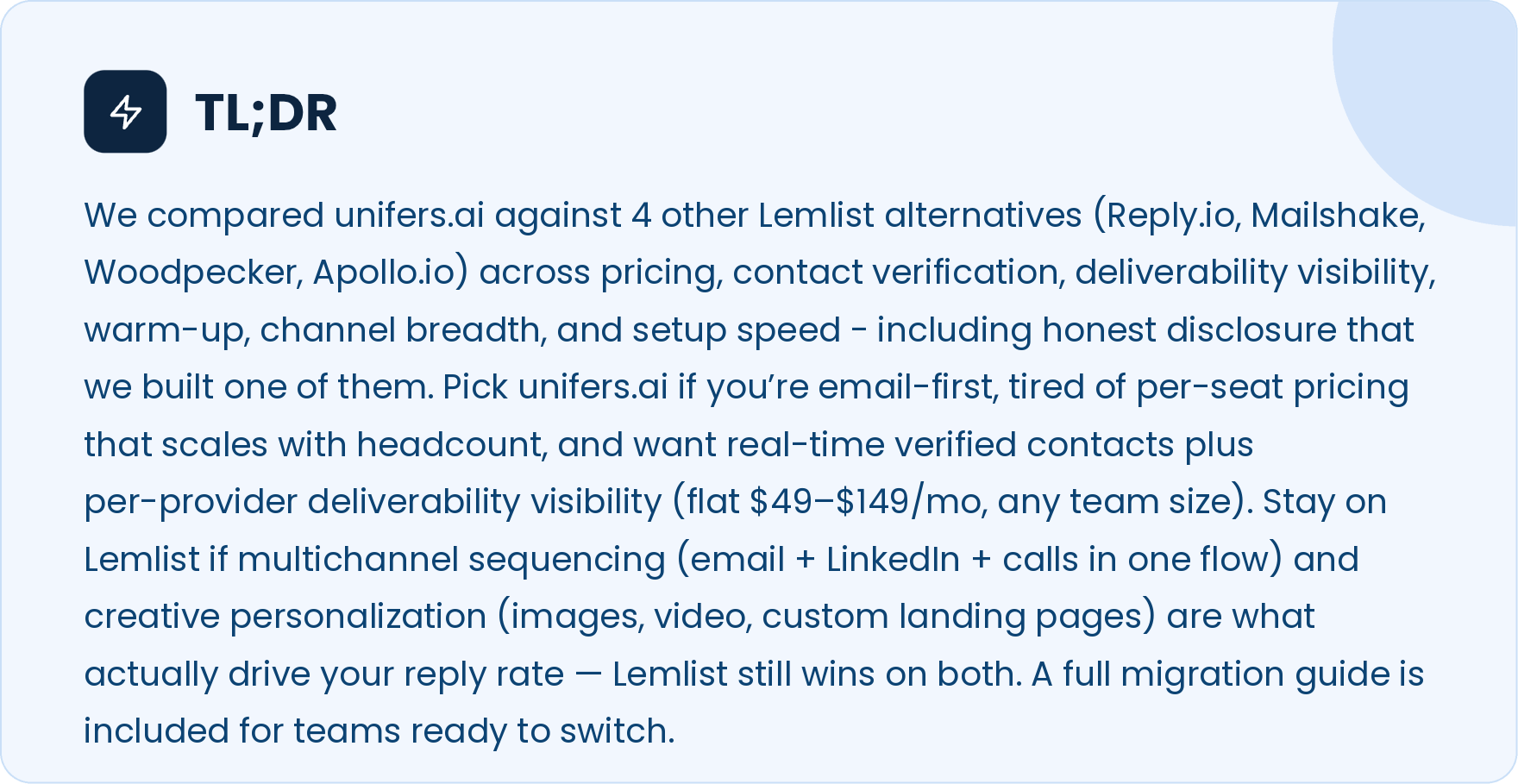
Pick unifers.ai if you're an email-first team of any size that wants verified contacts, per-provider deliverability visibility, and warm-up included in a per-user flat price you're tired of paying every time you add a teammate, or your bottleneck is knowing which mailbox provider is actually filtering your mail.
Pick Lemlist if multichannel sequencing (email plus LinkedIn plus calls, in one sequence) is the key to how your team sells, creative personalization (images, video, custom landing pages) measurably moves your reply rate, and you're a small enough team that per-seat pricing isn't the constraint yet.
Either way, both offer a way to test before you commit: run your own list through both and let your own reply and bounce rates decide.
Migration: Switching From Lemlist to unifers.ai (and When Not To)
Before switching, consider the question no one asks: is it the tool you don't like about Lemlist, or the workflow? A drop in reply rate this month is almost always not the tool: it's usually copy fatigue, list quality, or a reputation hit from a bad sending week.
Switching tools mid-reputation-problem makes it worse, as you'd be launching new accounts on top of an unresolved issue.
If that's ruled out and the bottleneck is genuinely tool-level (per-seat cost that no longer makes sense, no per-provider deliverability visibility, contact verification that costs you in bounces), here's the sequence we'd recommend:
Export from Lemlist. Save contact lists, campaign templates, and reply history as CSV. Map fields to unifers.ai's import format and test a small batch before pulling the full list.
Connect domains and verify DNS in unifers.ai. SPF, DKIM, and DMARC are configured automatically the moment an inbox is connected.
Run accounts in parallel for 7-14 days. Keep Lemlist campaigns running at reduced volume while unifers.ai's pre-warmed infrastructure takes over new sends, to protect pipeline during the switch.
Monitor bounce rate and per-provider placement. Bounce rate should stay under 2%; use unifers.ai's deliverability reporting to confirm placement before scaling volume back up.
Cut over and cancel. Once unifers.ai campaigns have held steady metrics for about two weeks, retire Lemlist campaigns: export reply history first, as most platforms purge data upon cancellation.
A short overlap period is worth a week's extra migration time. Teams that cut over in 48 hours risk a reputation dip that costs more pipeline than the migration was worth.
See unifers.ai's plans and try the free tier at unifers.ai.