- cold email
- sales tools
- sales automation
- lead generation
- email outreach
- email warmup
- contact verification
- sales engagement
- tech stack
Before You Send Your First Cold Email, How Many Tools Do You Have to Pay For?
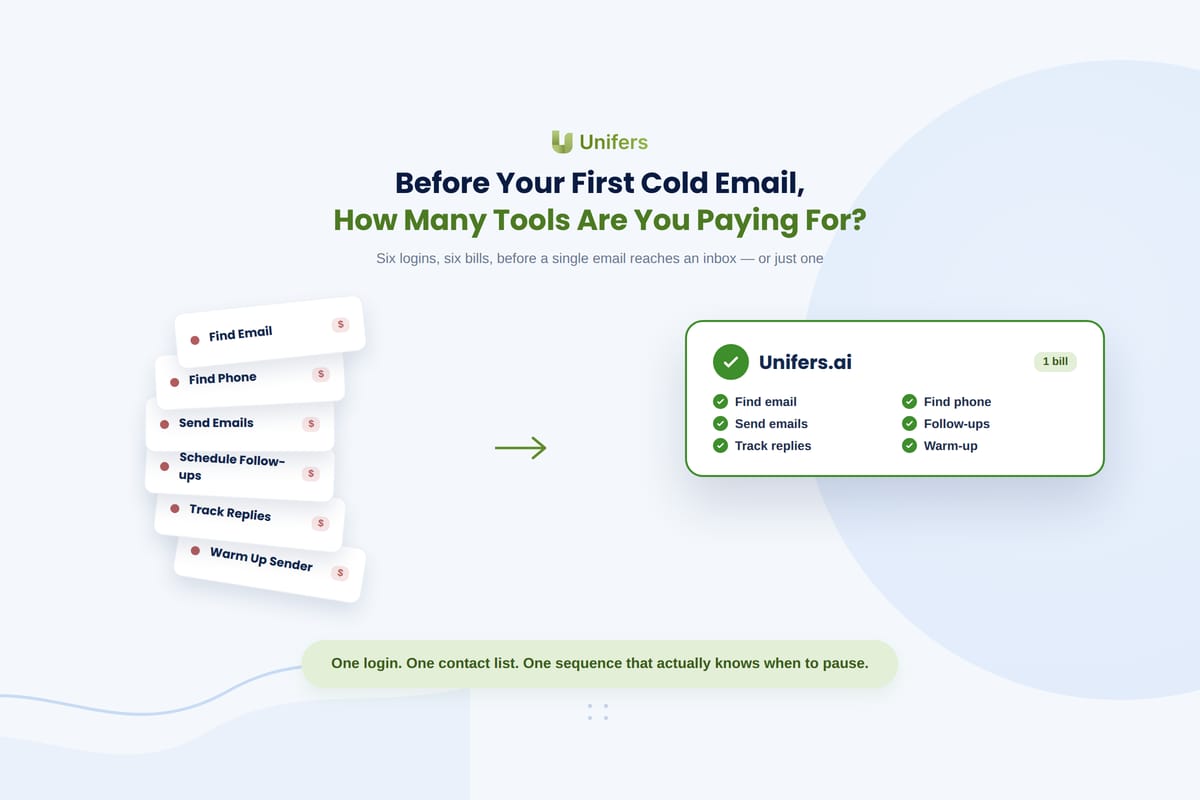
Most sales teams don't set out to adopt a six-tool stack.
It's more like one tool, then another, until someone eventually realizes this is how much they're spending to be able to get to the point where outreach can even begin.
The Stack No One Set Out To Create
It begins with finding a contact - a tool to pull an email address off a LinkedIn. It works until someone needs a phone number too, which the first tool doesn't offer, so they get a second.
Then actually sending the email, which neither of the first two tools handle, requiring a third. Not even having sent one yet, but knowing that cold outreach requires follow-ups on a schedule, a fourth is added to handle that. And somewhere in there is a desire to know if any of this is actually working, adding a fifth just for that. And underneath it all is a sending account that's unwarmed, since none of the first five had to be responsible for that either.
Six tools, six logins, six line items on six separate billing cycles, before a single cold email even finds an inbox.
None of these decisions were objectively wrong, nor were any of these tools objectively bad. The issue is that none of these six tools were used to solve anything that wasn't immediately obvious.
The True Cost Beyond These Six Subscriptions
While it's easy to point to these six subscriptions, their true cost is measured in other ways.
The maintenance of a contact list pulled from one tool, but that has to be exported and imported to the next. A reply that's logged in a tracking tool, but not paused by the outreach tool that's following up. An hour spent every week to make sure two sets of data are in sync, just to know which one to believe when they disagree.
The cost of the tool itself is obvious, but the opportunity cost of the tool's overhead is what matters.
What This Assumes About Sales Stacking
Sales tooling has long been a set of specialists, each solving one piece of a larger problem, because that's what the market demanded. The market asked for a better way to find contacts, then to identify which ones to target and outreach, to schedule follow-ups, to track opens and replies, to warm accounts before sending, and to send themselves. And each asked for them as an isolated problem to solve rather than part of a single solution, meaning no one tool had to do all of them.
What This Can Be Replaced With
This is what Unifers.ai was built to change.
A single place to find and verify contacts, warm them, send and track replies, schedule follow-ups, and do everything else required to turn one cold email into an engaged prospect.
One login, one list of contacts that never has to be re-uploaded, one sequence that actually pauses when a reply comes in because there's only one thing managing them in the first place.
It's not a smaller version of the six-tool stack, it's more like doing everything those six tools do, but without needing six different places to do them.
The Question No One Asks When They Ask This Question
It's not a matter of these six tools being the best at what they do, because the idea of six separate tools is already an unnecessary problem to solve.
A much more useful question to ask is, does sending a single cold email really have to begin with six different bills?
For most teams, the realization is that it shouldn't, they just didn't have the option before. That having something that could do all of this in one place hadn't existed until now.
See why one platform does everything that six were previously needed for.
Try Unifers.ai